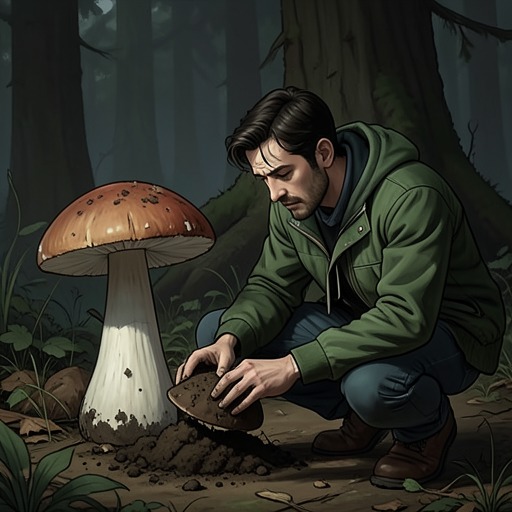
Stoned ape theory
How to Change Your MindStoned ape theory is the speculative claim that psilocybin mushrooms helped make human beings by changing the minds of their hominid ancestors. In Terence McKenna’s account, mushrooms did not merely alter consciousness temporarily: they helped bring forth self-reflection, language, and imagination, capacities that distinguish Homo sapiens. The theory’s force lies partly in the scale of its claim and partly in its reversal of the familiar picture of human evolution: here, a fungus may have helped shape the animal that would later explain the world.
Formulation and Central Claims
McKenna’s formulation, summarized in Food of the Gods (1992), gives psilocybin several related roles. Psilocybes, he proposed, gave hominid ancestors access to realms of supernatural power, catalyzed the emergence of human self-reflection, and helped move them from an animal mind into articulated speech and imagination. Together, these claims make the mushroom not simply an influence on human behavior but a proposed catalyst in the emergence of distinctively human mental capacities.
The theory’s most expansive version makes language a consequence of psychedelic experience. McKenna connects this claim to synesthesia, the blending of the senses associated with psychedelics: under psilocybin, numbers might acquire colors or colors attach to sounds. He treats language as a special case of that linking process, in which sounds that otherwise have no meaning become associated with concepts. On this account, a change in perception could have opened a path toward symbolic communication, and symbolic communication toward speech and imagination.
Stamets presented a related version of the hypothesis in an email, suggesting that psilocybin ingestion may have rapidly encouraged analytical thinking and social bonding in hominids. He also pointed to the reported mushroom-eating habits of 23 primate species, including humans, and to their ability to distinguish beneficial mushrooms from harmful ones. These observations make mushroom consumption seem less anomalous in primate life, but they do not by themselves demonstrate the evolutionary transformation proposed by the theory.
A Large Claim and a Missing Mechanism
The account distinguishes cultural influence from biological evolution. It would be difficult to make the consumption of soft-bodied mushrooms visible in the fossil record: they could be eaten fresh, leaving no durable trace, and their use would require neither specialized tools nor processing methods likely to survive. This absence makes the theory unusually resistant to direct archaeological confirmation. The same quality that leaves the hypothesis difficult to rule out also leaves little material evidence with which to establish it.
More consequentially, McKenna does not explain how mushroom consumption could have altered biological evolution by selecting for changes in the genome. A powerful or recurring experience might influence culture, but that possibility is not the same as showing how it produces inherited biological change. The distinction matters because the theory often moves between these scales: from an account of altered perception and social life to a claim about the transformation of hominid ancestors into Homo sapiens.
The book therefore treats Stoned ape theory as neither a demonstrated account of human origins nor a claim that can be neatly settled by a single missing fossil. Its proposed mushroom use may have left no fossil trace, while its biological mechanism remains unspecified. A case for cultural evolution, such as the kind R. Gordon Wasson made for the influence of psychoactive fungi, would have been easier to formulate than McKenna’s more ambitious claim about biological evolution. The central gap is not simply whether early hominids ate mushrooms, but how that experience could have produced the developmental consequences the theory assigns to it.
McKenna, Stamets, and the Theory’s Transmission
Stamets became close friends with McKenna during the last years of McKenna’s life. After McKenna died of brain cancer at fifty-three, Stamets continued to carry the theory into his talks, recounting and extending its argument. He acknowledges that it is difficult to prove to anyone’s satisfaction, yet considers it more likely than not that psilocybin was pivotal in human evolution. His advocacy thus preserves a distinction between evidentiary certainty and conviction: he recognizes the difficulty of proof without withdrawing the claim.
The theory also appears within a wider pattern the book identifies among myco-evangelists. People who experience the power of these mushrooms firsthand may emerge convinced that fungi are prime movers, capable of explaining a broad range of human and natural phenomena. Such conviction can take the form of a conversion narrative: experience is followed by a sense of discovery, and discovery by a mission to carry the message to others. McKenna’s theory gives that mission an origin story on a species-wide scale, making mushrooms actors in the making of human consciousness.
That pattern is visible in the account of Stamets’s mycocentric outlook. In a house filled with mushroom images and objects, he arranged mushroom stones with careful solemnity; his collection of Psilocybe images ranged from nature photography to cave paintings, petroglyphs, church architecture, and Islamic designs. The narrator often could not see the mushroom forms Stamets perceived in those images. This difference in perception helps explain the theory’s appeal and its difficulty: an all-encompassing fungal interpretation can turn scattered resemblances into a connected story, but the connections do not thereby become proof of evolutionary causation.
The Mushroom’s Point of View
The book carries McKenna’s speculation one step further by imagining the process from the mushroom’s perspective. What might have begun as a biochemical accident, it suggests, could be understood as a strategy that enlarged the mushroom’s range and numbers by winning the devotion of a mobile, inventive, communicative animal. In this imagined reversal, psilocybin helps form the very kind of mind equipped to spread the mushroom’s story: a mind with language, imagination, and the ability to travel.
This is not offered as an established account of fungal intention. Rather, it exposes the imaginative structure that makes the theory compelling: the mushroom becomes a possible agent in a history usually told as the story of human beings alone. The proposal that fungi helped produce language and self-reflection gives them a role in humanity’s emergence, while the proposed feedback between mushroom experience and human advocacy turns evolutionary speculation into a story about transmission. Its reach is also its limit. Stoned ape theory can frame a striking possibility about human and fungal entanglement, but the available evidence does not establish that psilocybin caused the biological changes it imagines.